experiment · · 8 min read
How many LinkedIn connection requests per week does prospecting take? Between 17 and 53, never more than 20 a day, no restriction in five weeks
173 connection requests to strangers from one LinkedIn account in five weeks, September 15 to October 16, 2026: between 17 and 53 a week, never more than 20 in a day, a pending pile that never passed 59, every unanswered request withdrawn after 21 days, and no warning from LinkedIn. What a real campaign needs, and how to keep the pending pile small.
by Thiago Valentim · Scout With Me, by Worth Contacting
The question behind "how many connection requests can I send" is usually fear. The account is worth more than any campaign, LinkedIn does not publish its limit, and every guide quotes a number someone else heard. I cannot tell you where the limit is, because in five weeks of real prospecting I never got near it. What I can tell you is what a real campaign actually needed, day by day, with the app keeping the count: how many requests went out, how many sat pending, when the unanswered ones were withdrawn, and what LinkedIn said about it, which was nothing.
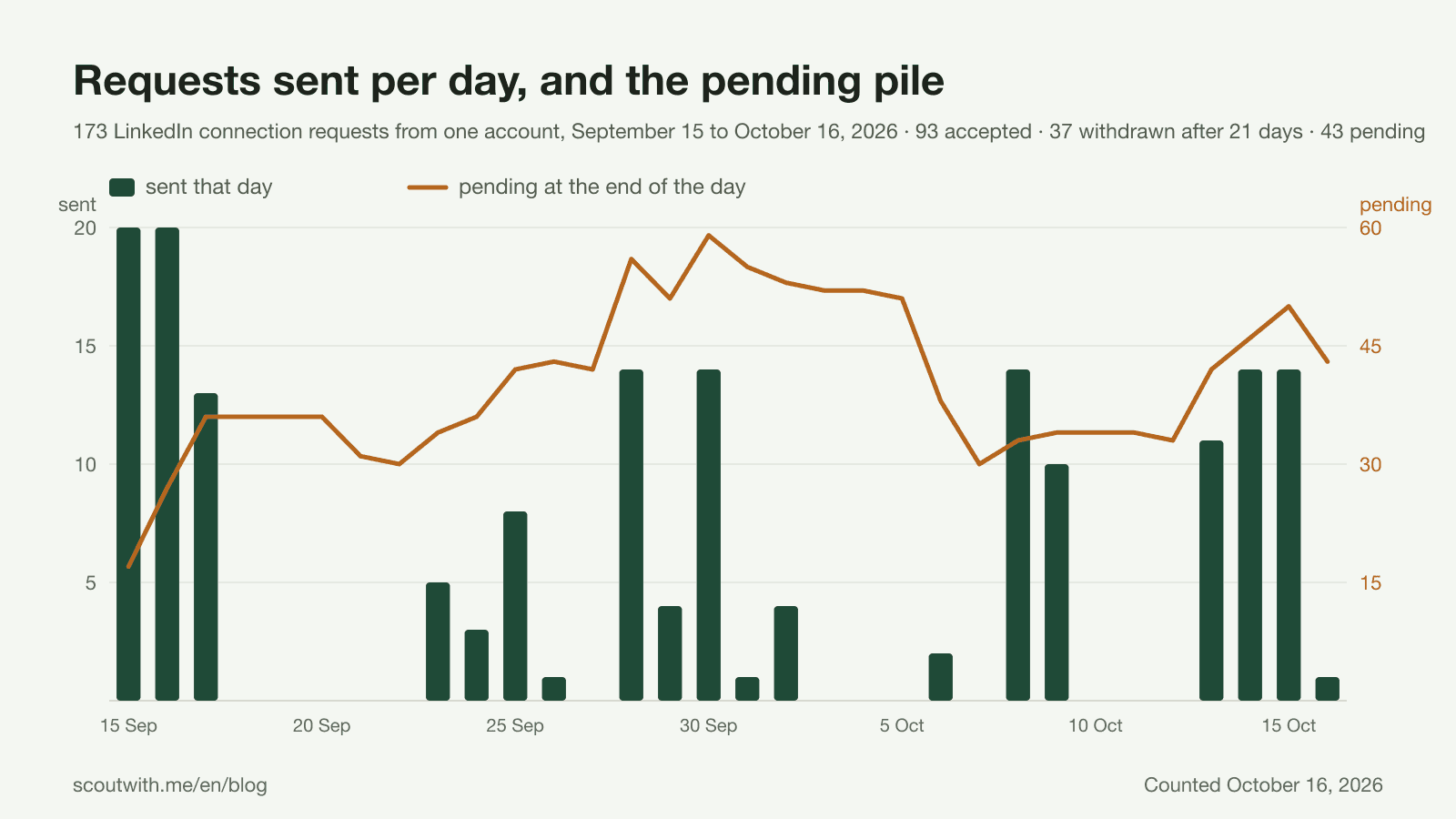
How many connection requests per week does LinkedIn prospecting take?
Between September 15 and October 16, 2026, 173 connection requests went out from one account, between 17 and 53 a week, under a ceiling of 100 a week set in the app and never reached, as counted on October 16. The ceiling is mine, not LinkedIn's. LinkedIn's own help page says only that limits exist and that a restriction lasts about a week once you hit one; the number members report is around a hundred. The campaign did not need half of it.
The weeks were uneven because the requests follow the people. A week with few profiles worth writing to is a week with few requests, and nothing in the app fills the gap with names that do not fit.
| Week of | Requests | Days with requests | Accepted | Withdrawn | Still pending |
|---|---|---|---|---|---|
| September 14 | 53 | 3 | 25 (47%) | 28 | 0 |
| September 21 | 17 | 4 | 8 (47%) | 9 | 0 |
| September 28 | 37 | 5 | 27 (73%) | 0 | 10 |
| October 5 | 26 | 3 | 12 (46%) | 0 | 14 |
| October 12, five days in | 40 | 4 | 21 (53%) | 0 | 19 |
Acceptances and withdrawals count in the week the request was sent, so the last rows are still moving.
How many connection requests per day?
Never more than 20: in the 32 days, 19 had requests, a median of 10 on those days and 20 on the two busiest, 13 had none, and the busiest single hour of the whole period had 9, as counted on October 16, 2026. The two fullest days were the first two, when the list was fresh. After that the pattern was bursts of ten to fourteen on the days when there were people worth writing to, and silence on the others.
| Requests in the day | Days |
|---|---|
| None | 13 |
| 1 to 9 | 9 |
| 10 to 19 | 8 |
| 20 | 2 |
They went out on working days, in working hours, because that is when the deciding happened.
| Day of the week | Requests | Time of day | Requests | |
|---|---|---|---|---|
| Monday | 14 | Morning, 6 to 12 | 41 | |
| Tuesday | 37 | Afternoon, 12 to 18 | 85 | |
| Wednesday | 53 | Evening, 18 to 24 | 47 | |
| Thursday | 45 | Night, 0 to 6 | 0 | |
| Friday | 23 | |||
| Saturday | 1 | |||
| Sunday | 0 |
How many pending connection requests are too many?
The pending pile never passed 59: it peaked on September 30, 2026, averaged 40 over the 32 days and stood at 43 on October 16. The pile is the number nobody watches. Every request that has been neither accepted nor withdrawn sits in it; it grows on sending days and shrinks on the days people accept or the app withdraws, which is the orange line in the chart above.
It matters because of the order of events. LinkedIn's help page says that withdrawing pending invitations does not remove a restriction once you have one, so the pile has to be kept small before, not emptied after. I do not know where LinkedIn's threshold is. I know that 59 was fine, and that the way to stay there is the next section.
When should you withdraw a pending LinkedIn request?
At three weeks: the app withdrew 37 requests, every one of them 21 days after it went out, and none of the 93 acceptances came after day 21; withdrawing at day 7 would have cost 4 of them, at day 14 two, as counted on October 16, 2026.
| Accepted | People |
|---|---|
| Within a day | 65 |
| Day 2 to day 3 | 12 |
| Day 4 to day 7 | 12 |
| Day 8 to day 14 | 2 |
| Day 15 to day 21 | 2 |
| After day 21 | 0 |
Two different questions hide in "when do I give up". For planning, a request is a no after a week, because almost everyone who will accept has done it by then; that rule is in How long does a LinkedIn connection request take to be accepted? For withdrawing, there is no reason to hurry: leaving the request three weeks cost nothing, kept the pile at the size above, and still caught the four people who took more than a week. Of the 69 requests old enough to have passed day 21, 32 were accepted and 37 withdrawn, none left hanging.
Did LinkedIn restrict the account?
No. In 32 days and 173 requests there was no warning and no restriction. That is the whole finding, and it has a shape to respect: one account, one campaign, numbers a third of what members report as the limit. It shows what did not get restricted, not where the line is.
What to do with this
- Set your own ceiling below the number people report, and expect to use a third of it. Mine is 100 a week; the fullest week used 53.
- Send in bursts on the days there are people worth writing to, up to about 20, and send nothing on the others. Thirteen of 32 days had no request, and nothing broke.
- Watch the pile, not the day. Count the requests that are neither accepted nor withdrawn; mine never passed 59.
- Withdraw at three weeks, not one. One week would have cost 4 acceptances in 93; three weeks cost none.
- Send on weekdays, in working hours. One of 173 went out on a weekend.
Scout sends the requests at a human pace, under a ceiling you set, withdraws what is not accepted after three weeks and keeps this count for you; who gets a request stays yours.
How these numbers were measured
- Source: Scout running on my own LinkedIn account, prospecting for real, for the products I sell. No data from other users of Scout; the app keeps its data on each user's computer and sends nothing to us.
- What was counted: request, a connection request sent with a note written from the profile, to someone who was not a connection; accepted, the time the app's scan saw the acceptance, not the moment of the person's click; withdrawn, the app withdrew the request after 21 days without an answer, its current setting, and no withdrawn request had been accepted; pending, neither accepted nor withdrawn; pending pile, the pending requests at the end of each day; weeks run Monday to Sunday.
- When: requests sent from September 15 to October 16, 2026; read from a copy of the database taken at 22:48 on October 16, local time of the account (Eastern European Summer Time). October 16 is a partial day.
- Size and rounding: 173 requests over 32 days. "A third of the limit" compares the fullest week, 53, with the 100-a-week ceiling set in the app. Rates are rounded to whole percentages.
- Not measured: LinkedIn's own limit, and what happens above these numbers. One account cannot show where the line is, only that these numbers stayed under it.
- Left out: one person who was already a connection and got no request. Nobody is named.
- The rules that apply to every post are in How the numbers on this blog are measured. Every rate on this blog, refreshed together, is on the benchmark page.
This is a living page: the requests keep going out, and the changelog below says when the counts were last read.
Changelog
- 2026-10-16: first version. 173 requests from September 15 to October 16, with acceptances, withdrawals and the pending pile per day, read on October 16.