experiment · · 9 min read
How much time does LinkedIn prospecting take per week? 287 decisions in four weeks, about half a minute each
Four weeks, 158 connection requests, 75 accepted, 47 replies, and every decision of mine stamped with its time: 287 decisions on 24 of 29 days, a median of 9 a day, in sessions of 3 or 4 decisions that take under two minutes. The arithmetic of the week, what the stamps do not see, and how to keep it that small.
by Thiago Valentim · Scout With Me, by Worth Contacting · updated
Ask anyone who already prospects on LinkedIn what it costs them and they will not say money. They will describe an afternoon that disappeared: the search, the profiles, the note rewritten three times, the follow-up forgotten, the tab kept open all day in case someone answers. That afternoon is the reason most people stop.
I wanted to know what it had actually cost me, so I let the app keep the clock. For four weeks, from September 16 to October 14, every decision I made was stamped with its time: a draft approved, a draft sent back, a conversation taken into my own hands. At the end there were 287 stamps, and they tell a story that is a lot smaller than the afternoon.
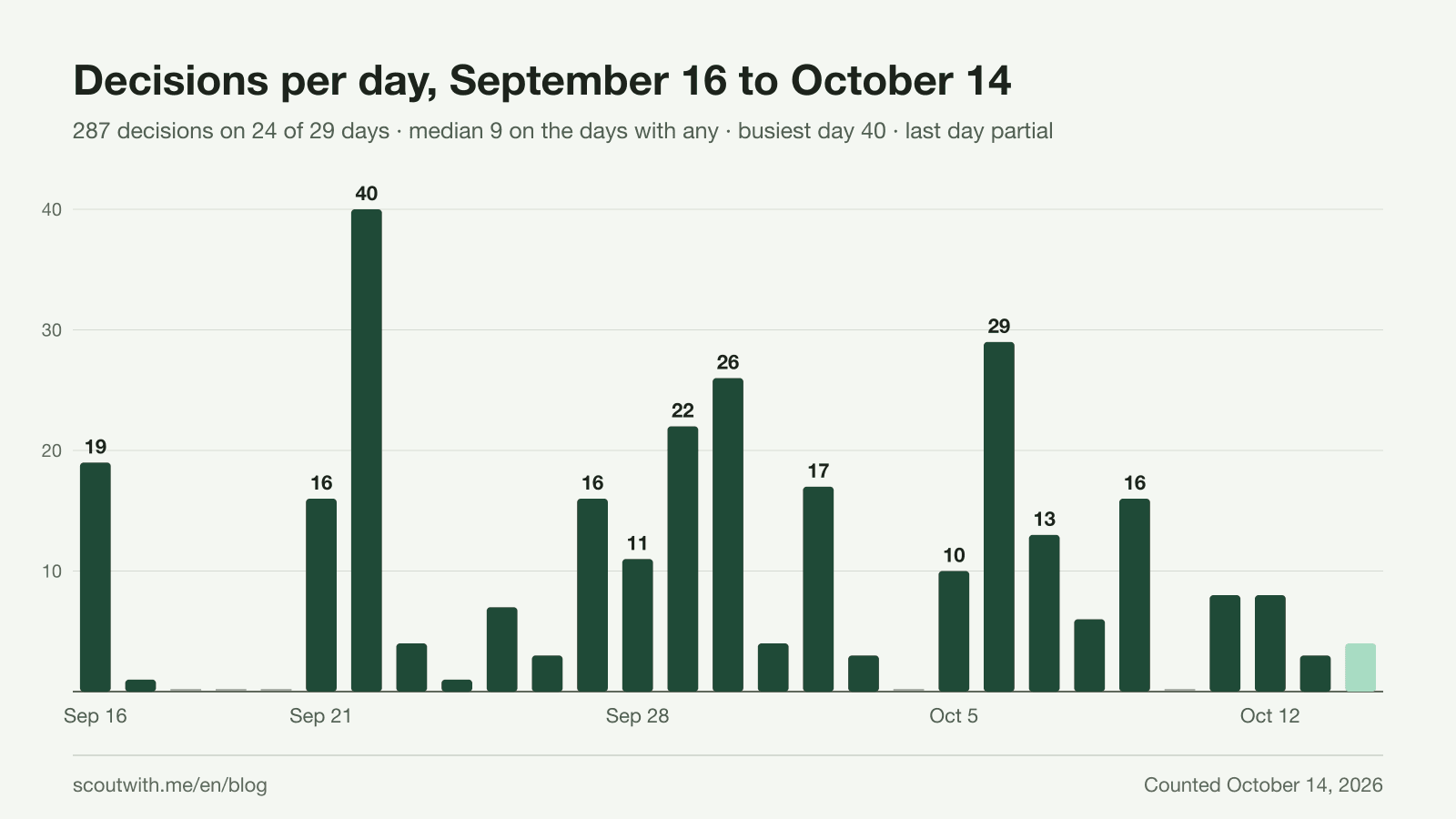
How many decisions does LinkedIn prospecting take per day?
Between September 16 and October 14, 2026, 287 decisions of mine were stamped on 24 of the 29 days, a median of 9 on the days with any, as counted on October 14. So on a normal day, about nine, and a normal day looks like this. Overnight the app has found a few people, read their profiles and drafted a note for each. I open it and read the first draft. It sounds like me, so I approve it. The next one does not, so I send it back and a new version comes. A reply has arrived from someone I wrote to last week, and there is a draft answer waiting; same thing, read and decide. Once in a while I disagree with the app about whether a person fits at all, and I say so. Five times in four weeks I took a conversation out of its hands and wrote myself.
Every one of those moments is a stamp, and they come in five kinds:
| What I decided | Times | Share |
|---|---|---|
| Approved a draft, a note or a message | 204 | 71% |
| Asked for another version of a draft | 68 | 24% |
| Discarded a reply | 2 | 1% |
| Corrected the call on whether a person fit | 8 | 3% |
| Took over a conversation myself | 5 | 2% |
Five of the 29 days had no stamps at all, and nothing broke; the requests kept going out and the replies kept arriving. The busiest day had forty, and that was not a normal day. It was the day I taught the drafts to sound like me, which comes later in this post. Drafts the app approved on its own and discards it did not time are not in the count, because they were not my minute.
How long does each decision take?
About half a minute: in the 54 sessions with two or more decisions, counted on October 14, 2026, the median gap between one decision and the next was half a minute, and the typical session was three or four decisions in under two minutes. I know that because the stamps come in clusters: when decisions fall within twenty minutes of each other I call them a session, with a first stamp and a last one.
The session I would show to anyone who believes this eats the day happened on a Sunday night, October 11, between 21:34 and 21:35: eight drafts read and approved in 84 seconds, done before the kettle boiled. That is what the work looks like when the drafts are right. The sessions that ran long are the ones where I did the writing: on the afternoon of September 29 I took three conversations into my own hands, and ten decisions took 22 minutes. Writing is slow. Deciding is not.
| Day | Decisions | Minutes | What was in it |
|---|---|---|---|
| September 22 | 21 | 18.0 | 6 approved, 15 sent back |
| October 6 | 16 | 11.0 | 7 approved, 9 sent back |
| September 21 | 16 | 7.7 | 6 approved, 10 sent back |
| September 29 | 10 | 22.1 | 4 approved, 3 sent back, 3 conversations taken over |
| September 22 | 10 | 21.1 | 10 approved |
| September 27 | 8 | 3.1 | 3 approved, 5 sent back |
| September 16 | 8 | 2.6 | 8 approved |
| September 30 | 8 | 2.6 | 8 fit calls corrected |
| October 11 | 8 | 1.4 | 8 approved |
| October 7 | 7 | 8.2 | 3 approved, 4 sent back |
What the stamps cannot see is the moment before the first one: opening the app, reading the draft, the breath before deciding. A session that reads 1.4 minutes was longer than that in real life, and I do not know by how much. The honest number is the one I have, with that caveat attached.
How many hours a week is that?
Less than an hour, even being generous: 287 decisions at about half a minute each add up to roughly two and a half hours over the four weeks to October 14, 2026, around 35 minutes a week. Double it to cover the opening and the reading the stamps do not see, and it is still about an hour.
The usual advice is thirty to sixty minutes a day, and I believe it, because that is what a day costs when the finding, the reading of profiles and the writing are also yours. Here those three happen before I open the app. What is left is deciding, and deciding is fast when the draft in front of you is about the person it is going to.
Where does the week go?
To the second week: of the 287 decisions, 87 fell in the week of September 21, 2026, and 39 of those were drafts sent back, more than in the other three weeks together. It was worth it.
| Week of | Decisions | Approved | Sent back | Other |
|---|---|---|---|---|
| September 14 | 20 | 18 | 2 | |
| September 21 | 87 | 45 | 39 | 1 reply discarded, 2 conversations taken over |
| September 28 | 83 | 63 | 9 | 8 fit calls corrected, 3 conversations taken over |
| October 5 | 82 | 63 | 18 | 1 reply discarded |
| October 12, three days in | 15 | 15 | 0 |
That second week I sent back more drafts than in the other three weeks together. They were not wrong. They were not mine yet: a little too smooth, a little too eager, the kind of note you can tell was assembled. Three of the people who replied later said exactly that about the first message they got, and they were right. So for a week I read every draft as if it carried my name and sent back the ones that did not, and on September 22 that took eighteen minutes in one sitting, the longest session of the month. After that week, four drafts in five went out as they came. Tuning the voice is a cost you pay once, and the stamps show the exact week I paid it.
What the four weeks produced
In the four weeks to October 14, 2026, 158 strangers got a request, 75 accepted, 47 wrote back, and 34 of them replied to the very first message. Not a calendar full of calls, which is part of why this post exists: the hour a week is not a promise of customers, it is the price of finding out. The rates and the timings live on the benchmark page, refreshed every week; what the replies actually said, tone by tone, is in Is it rude to cold message strangers on LinkedIn?
What to do with this
- Decide in batches, once or twice a day. A session of four decisions takes two minutes; four sessions of one take four openings and the whole day in between.
- Send drafts back without guilt. A draft sent back costs the same half minute as one approved, and the week you spend tuning the voice is paid once.
- Take over a conversation only when it has earned it. Those were the only slow sessions in the month.
- Count the decisions, not the hours. The hours are where the dread lives; the decisions are what the day actually asks of you.
Scout does the finding, the reading of profiles and the first drafts on your computer, on your account, and stamps each decision so a count like this can exist; the deciding, the replying and the stopping stay yours.
How these numbers were measured
- Source: Scout running on my own LinkedIn account, prospecting for real, for the products I sell. No data from other users of Scout; the app keeps its data on each user's computer and sends nothing to us.
- What was counted: decision, an action of mine the app records with its time: approving a draft, asking for another version, discarding a reply, correcting the call on whether a person fits, taking over a conversation. Drafts the app approved on its own (17) and discards it did not time (7) are not decisions. Session, decisions with no more than twenty minutes between one and the next; its length runs from the first decision to the last.
- When: September 16 to October 14, 2026, counted on the evening of October 14; October 14 is a partial day.
- Not measured: the time between opening the app and the first decision, and the reading before it. Time per decision is the session length divided by its decisions, so it includes the pauses inside a session and excludes the lead-in.
- Size and rounding: 287 decisions, 81 sessions, 54 of them with two or more decisions. Minutes to one decimal; "half a minute" is the median gap between consecutive decisions; "35 minutes a week" is 287 times half a minute over 29 days.
- Left out: nothing about who the people are; no message is quoted.
- The rules that apply to every post are in How the numbers on this blog are measured.
This is a living page: the decisions keep being stamped, and the changelog below says what changed.
Changelog
- 2026-10-14: first version. 287 decisions from September 16 to October 14, read on October 14.
- 2026-10-15: rewritten for reading, with the numbers unchanged.
- 2026-10-16: each question section now opens with its number, base and count date in one sentence; numbers unchanged.