experiment · · 5 min read
Does posting on LinkedIn predict who replies? Recent posters accepted and replied two to three times more often
One week, 102 connection requests from my own account: 44 accepted, 26 replied, 17 interested. Split by one signal, recent posting, the rates double and triple.
by Thiago Valentim · Scout With Me, by Worth Contacting · updated
One week, my own LinkedIn account, Scout running the outreach: 148 profiles visited, 102 connection requests sent, 44 accepted, 26 replied, 17 said they were interested. Each request carried a short note written from the person's profile, and I approved every one before it went out. One thing separated the people who answered from the people who did not, and it was visible on every profile before a word was written: whether the person had posted recently.
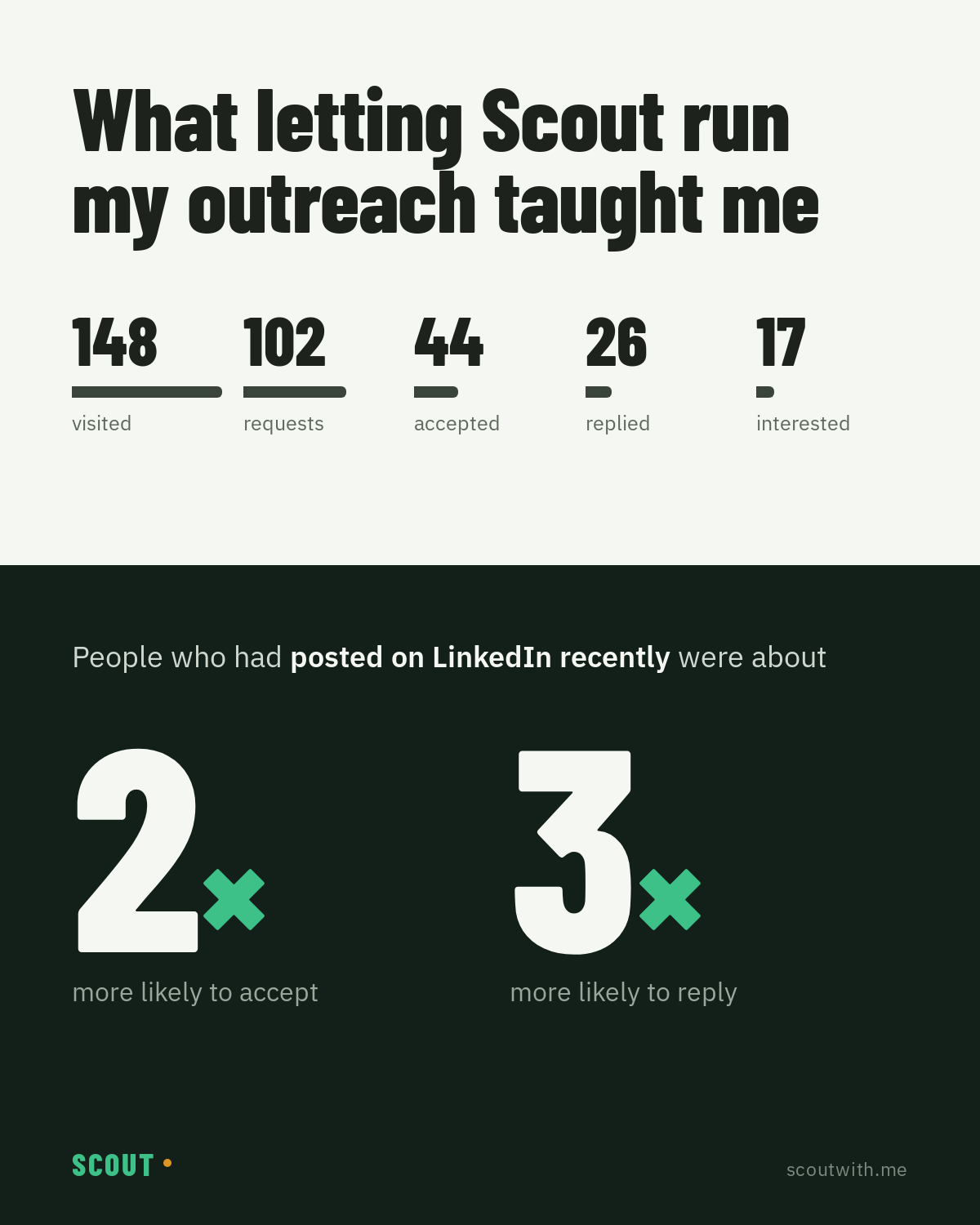
It started as a post on X. This is the version with the numbers laid out, so there is somewhere to point when they get quoted.
What is a good acceptance rate for LinkedIn connection requests?
Of 102 connection requests to strangers, 44 were accepted and 26 of those 44 replied, as counted on October 1, 2026. That is 43 out of every 100 requests accepted, with this offer, in this batch, and most of the people who accepted going on to reply.
| Step | People | Rate |
|---|---|---|
| Profiles visited | 148 | |
| Connection requests sent | 102 | 69% of visited |
| Accepted | 44 | 43% of requests |
| Replied | 26 | 59% of accepted, 25% of requests |
| Interested | 17 | 65% of replies, 17% of requests |
The 46 visited profiles that got no request were read and left out: no fit, no message. A request only went to someone whose profile gave a reason to write.
Treat these as one reference point, not an average: one account, one offer, one week. What a single week gives you, and an average never does, is the comparison below, with the same kind of note on both sides.
Does it matter whether the person is active on LinkedIn?
Yes: in this batch of 102, as counted on October 1, 2026, the people who had posted recently were about 2x as likely to accept and about 3x as likely to reply as the people who had not. That is more than "it helps", and it comes from one thing anyone can see on a profile, the activity tab.
The obvious reading is right: someone who posts is on LinkedIn that week, sees the request, and is in the habit of answering. Someone who has not posted in months may not even see it. Obvious is not the same as measured, though. Before this week I would have guessed "a bit more". A 2x and 3x gap changes what you do with the list.
Who should you message first when prospecting on LinkedIn?
The people who posted recently: in this batch of 102 they replied about three times as often as the people who had not, as counted on October 1, 2026, and that is not the only reason. Invites are the scarce resource: to keep an account safe you stay well under what LinkedIn allows, which LinkedIn does not publish as a number, only as a restriction that lasts about a week once you hit it; the figure members report is around a hundred a week. So every request sent to someone inactive is a request not sent to someone who would have replied.
The rule this week produced:
- Before sending anything, sort the list by the date of the last post. It is on every profile, under activity.
- Spend the week's invites on the people with a recent post.
- Keep the rest. They are not a bad list, they are next month's list, to revisit when they show up again.
How do you get more replies to LinkedIn connection requests?
In this batch of 102, every note was written from the person's profile, nothing generic, and the variable that separated the 26 replies from the silence was who received the note, not what it said. Reading the profile is what gets you a reply from someone who is there. Choosing someone who is there is what gets the note read at all.
What to do with this
Open the activity tab before you write. Message the people with a post this month first, and write each note from what their profile says. That is the whole rule, and it is cheap to follow by hand on a short list. Scout does the sorting, the reading and the drafting for you, from your computer, on your account; the approving and the talking stay yours.
How these numbers were measured
- Source: Scout running on my own LinkedIn account, prospecting for real. No data from other users of Scout; the app keeps its data on each user's computer and sends nothing to us.
- What was counted: visited, a profile opened and read; connection request, sent with a note written from that profile; accepted, the request was accepted; replied, the person wrote back at least once after accepting; interested, a reply that, read in the conversation, was marked as interest.
- "Posted recently": what the activity tab of the profile shows at the moment it is read, a post within the last few weeks, with no finer cut than that.
- When: one week of requests; acceptances, replies and interest counted as of the day of the post on X.
- Size and rounding: 102 requests. The groups are small, and "2x" and "3x" are rounded ratios.
- Left out: the 46 visited profiles that got no request are not in the comparison. Nobody is named; only aggregates.
- The rules that apply to every post are in How the numbers on this blog are measured.
This is the first data point of a benchmark that gets updated with each run.
Changelog
- 2026-10-07: first version. 102 requests, with acceptances, replies and interest as counted on October 1.
- 2026-10-16: each question section now opens with its number, base and count date in one sentence; numbers unchanged.