experiment · · 9 min read
Do LinkedIn follow-ups work? The first one brings back a third of the silent, the second one almost nobody
89 strangers accepted my connection request and got a first message; 41 replied to it. One follow-up to the 37 who had stayed silent brought 12 of them back. A second follow-up to 17 people brought one reply, and it was a no. What a follow-up adds, when to send it, and when silence is the answer.
by Thiago Valentim · Scout With Me, by Worth Contacting · updated
The request gets accepted, the first message goes out, and then comes the part nobody writes guides about: nothing. More than half of the people who accept a connection request and receive a message do not answer it. That is the moment every prospector asks the same three questions. Write again? How many times? And when does it stop being persistence and start being noise?
I had 89 people to ask that of. Between September 15 and October 15 they accepted my connection request, every one of them a stranger chosen from their profile, and each got a first message written from it. The app kept the record of what every person received, on which day, and when they wrote back, so for once the follow-up question has a count behind it instead of a feeling.
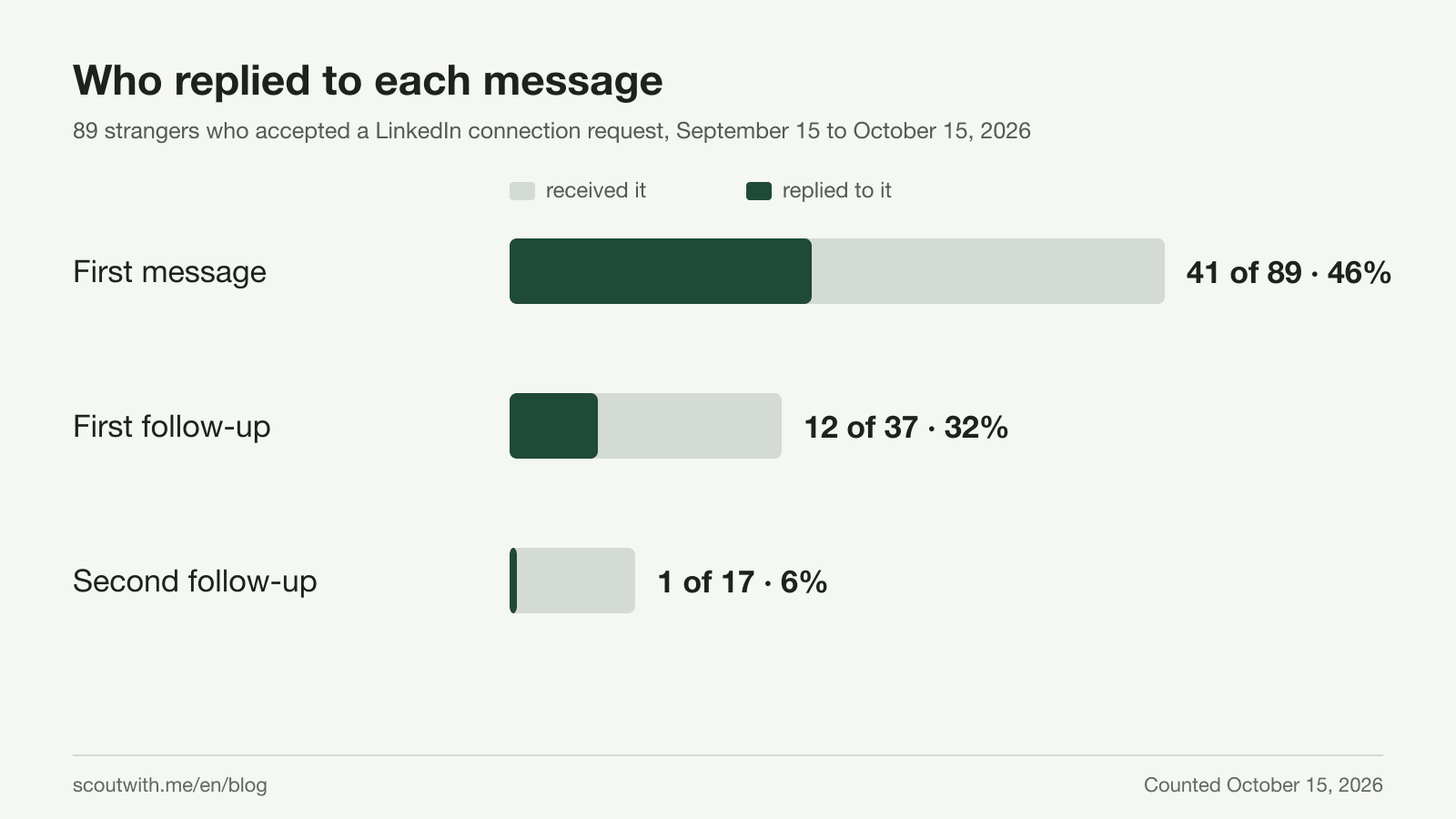
How many people reply to the first LinkedIn message after accepting?
Just under half: of the 89 people who accepted and got a first message, 41 wrote back to it, as counted on October 15, 2026, most of them the same day and without needing anything more from me. The rest went quiet, and quiet is where the follow-up question begins.
| What the person did | People | Share |
|---|---|---|
| Replied to the first message | 41 | 46% |
| Replied only after the first follow-up | 11 | 12% |
| Replied only after the second follow-up | 1 | 1% |
| Wrote to me before my first message went out | 1 | 1% |
| Silent after two follow-ups | 16 | 18% |
| Silent so far, next message not yet sent | 19 | 21% |
One person wrote to me before my first message had gone out, which counts as a reply but not as a reply to anything of mine. The nineteen in the last row are the newest: their last message from me is recent enough that a reply may still come, and the next message has not gone yet.
How many people reply to a LinkedIn follow-up?
About one in three: of the 37 people who got a first follow-up after not answering the first message, 12 replied to it, as counted on October 15, 2026. The fair way to count is to look only at the people who had a full week to answer, and there the picture holds: 10 of 28.
| Message | People who got it | Replied to it | Rate | Only those with a full week to answer |
|---|---|---|---|---|
| First message | 89 | 41 | 46% | 27 of 61 |
| First follow-up | 37 | 12 | 32% | 10 of 28 |
| Second follow-up | 17 | 1 | 6% | 0 of 7 |
For scale, the platform-wide benchmark that Expandi publishes from 13,302 accounts pools every kind of message, follow-ups included, into one reply rate per touchpoint of 10.4%. Here each message gets its own rate, and the first follow-up alone did three times that. The difference is not the follow-up; it is who received it. These were strangers chosen one by one and messaged with a note about their own profile, so the follow-up landed on someone who already had a reason to be in the conversation.
Does a second follow-up on LinkedIn work?
No: of the 17 people who got a second follow-up, one replied, politely, to say no, as counted on October 15, 2026, and that one reply says why. Seventeen people who had let two messages pass got a third; sixteen let that one pass too. Among the people who had a full week to think about it, nobody replied at all: 0 of 7.
The second follow-up did not find anyone who had wanted to talk and simply missed the earlier messages. It found one person who had been quietly declining and now had to say it out loud. Silence after a first follow-up is not a lost message. It is an answer in a quieter form, and the third message only asks the person to repeat it.
How much does a follow-up add to the reply rate?
About twelve points, all of them from the first one: on the 89 people, the reply rate went from 46% with the first message alone to 58% with one follow-up and 60% with two, as counted on October 15, 2026.
| Messages sent | People who had replied | Reply rate |
|---|---|---|
| First message only | 41 | 46% |
| Plus one follow-up | 52 | 58% |
| Plus a second follow-up | 53 | 60% |
If the first message alone had been the whole campaign, 41 people would have written back. The first follow-up added eleven whose first word came only after it: a quarter more conversations, for the cost of one short message to 37 people. The second follow-up added one, and it was the no above. With the person who wrote first, the total comes to 54 of 89. On this batch, every conversation worth having was reachable with two messages: the first, and one follow-up.
When should you send a LinkedIn follow-up?
Three or four days after the first message: 44 of the 54 first replies arrived within 24 hours, and the follow-ups I sent between three and six days later came back at the same rate whatever the gap, as counted on October 15, 2026. Replies to a message stop coming fast; half of all first replies came within six hours of mine.
| First reply after my message | People | Share |
|---|---|---|
| Within 24 hours | 44 | 81% |
| Later | 10 | 19% |
Mine went out between three and six days after the first message, four days on the typical one, and inside that range the gap made no visible difference. The people who got their follow-up early came back at the same rate as the people who got it late.
| Gap before the first follow-up | People | Replied to it |
|---|---|---|
| Under four days | 16 | 5 |
| Four days or more | 21 | 7 |
So a follow-up on the third or fourth day of silence cuts almost nobody off, and waiting until the sixth day finds nobody extra. The second follow-up went out about six days after the first one, and that is the message nobody answered. The reply window for any single message is about a day; silence past it is already information.
What to do with this
- Send one follow-up to everyone who accepted and did not answer. It brings back about a third of them, the cheapest gain in the whole funnel.
- Send it after three or four days of silence. Four people in five who reply to a message do it within a day, and in this batch waiting five or six days instead of three found no one extra.
- Do not send a second. In this batch it produced one reply in seventeen, and the reply was a no.
- Read silence after the follow-up as the answer. Sixteen people let three messages pass; none of them was rude, and none of them was going to be a conversation.
- Expect the follow-up to lift replies by about a quarter, not to double them. The first message does most of the work, and the follow-up only works on people who had a reason to be there.
Scout drafts the first message and the follow-up from the person's profile and keeps the gap between them on its own; approving each one, replying and deciding when to stop stay yours.
How these numbers were measured
- Source: Scout running on my own LinkedIn account, prospecting for real, for the products I sell. No data from other users of Scout; the app keeps its data on each user's computer and sends nothing to us. The platform-wide figure is Expandi's, linked above, and is theirs alone.
- What was counted: first message, the message sent after the person accepted the connection request; follow-up, a further message to someone who had not replied to the previous one; replied to a message, the person wrote after that message and before the next one; first reply, the message of mine that preceded the person's first message; gap, the days between my previous message to that person and the follow-up; a full week to answer, the message went out at least seven days before the count.
- When: connection requests sent from September 15 to October 15, 2026; messages and replies counted on the evening of October 15. The last days' messages are still inside their window, so the follow-up counts can grow.
- Size and rounding: 89 people accepted and got a first message, 37 got a first follow-up, 17 got a second. "A third" is 12 of 37 and 10 of 28. Rates are rounded to whole percentages; the shares in the first table add up to 99 because of rounding. The gap groups have 16 and 21 people, so read them as a direction.
- Not measured: the tone of replies to follow-ups separately from replies to first messages. Tone is read per person, across all their messages, in Is it rude to cold message strangers on LinkedIn?
- Left out: the people who did not accept the request, 81 of 172, and two who accepted and had not yet received a first message. Nobody is named, no message is quoted.
- The rules that apply to every post are in How the numbers on this blog are measured. Every rate on this blog, refreshed together, is on the benchmark page.
This is a living page: the last follow-ups are still inside their week, and the changelog below says when the counts were last read.
Changelog
- 2026-10-15: first version. 89 first messages, 37 first follow-ups and 17 second follow-ups from the requests of September 15 to October 15, counted on October 15.
- 2026-10-16: each question section now opens with its number, base and count date in one sentence; numbers unchanged.