experiment · · 11 min read
How many LinkedIn profiles do you have to read to find one worth messaging? 4 in 10 names from a search were worth opening, 7 in 10 opened were worth a request, and one conversation took 18 names
565 people read from LinkedIn searches by one account between September 14 and October 13, 2026. At first look in the search results, 246 fit, 147 were a maybe and 172 did not fit. I opened 228 profiles; 160 were worth a connection request, 86 accepted, 53 replied and 32 turned into a conversation. The post explains why 68 opened profiles were not worth a message, what became of the maybes, and how many names one conversation took.
by Thiago Valentim · Scout With Me, by Worth Contacting
Nobody counts the reading. A campaign gets measured from the first connection request on, and the hours before it, scrolling a search and opening profile after profile to decide who deserves a message, go unrecorded, which is why they feel endless. I let the app keep that count for a month: every name a search returned, what the first look at the search result said, every profile opened, every one it passed or closed and why, and what the ones that passed turned into. The answer to "how many profiles do I have to read" came out as three numbers: 4 in 10 names from a search were worth opening, 7 in 10 opened profiles were worth a request, and one conversation took 18 names.
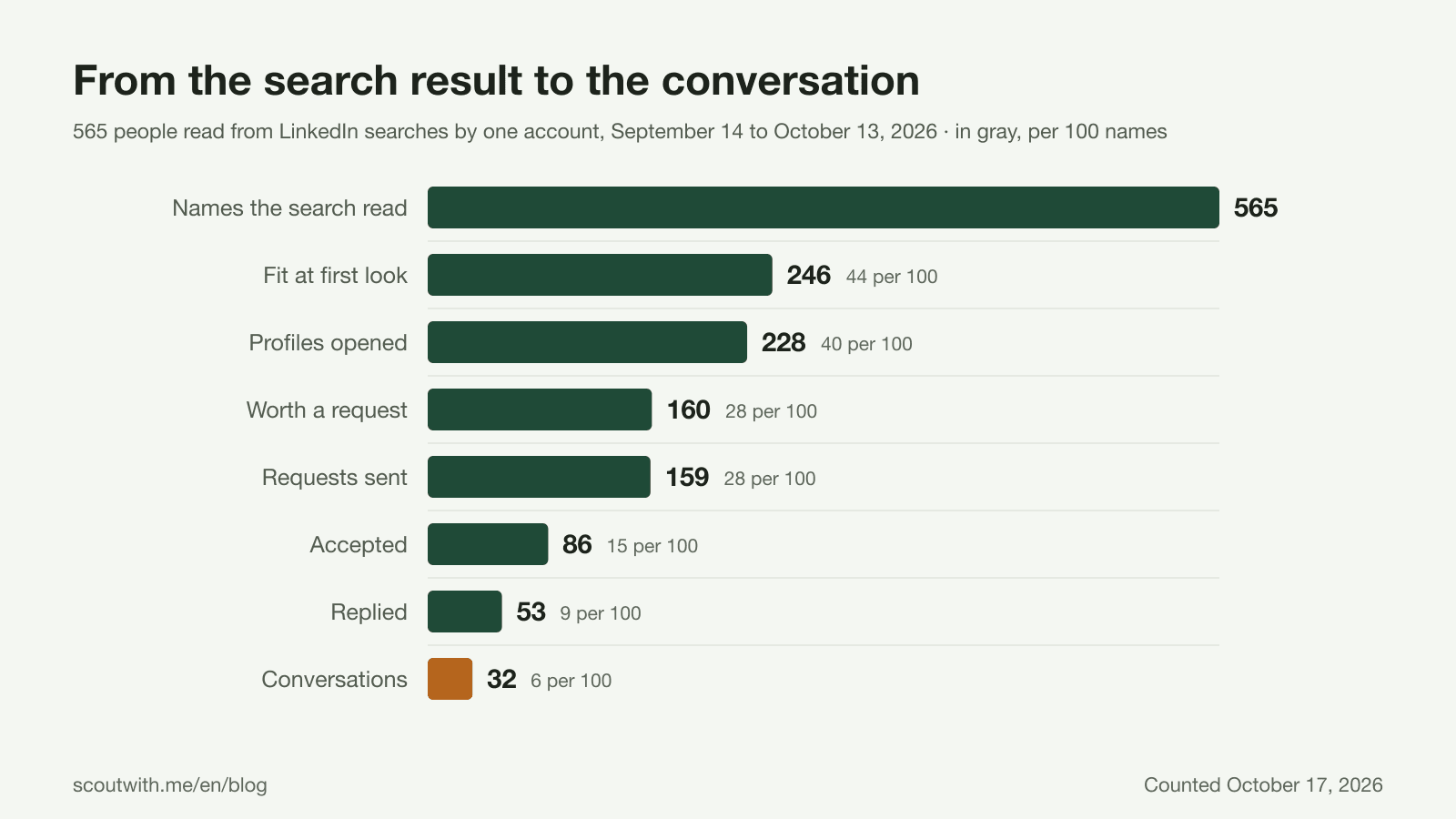
How many LinkedIn profiles do you have to read to find one worth messaging?
Between September 14 and October 13, 2026, searches on one account read 565 people, 228 profiles were opened and 160 passed the reading, so 4 in 10 names were worth opening and 7 in 10 opened profiles were worth a connection request, as counted on October 17. There are two filters, in order. The first is the first look, at the search result itself: the few lines LinkedIn shows before you open anyone, the name, the headline and the location, read against the customer profile I had written. Of the 565 results, 246 fit at first look, 147 were a maybe and 172 did not fit. I opened the ones that fit, and 5 maybes in the first week. Twenty-three that fit stayed closed: 7 I overruled by hand, 16 I never put on a list, 15 of them from the last search. The second filter is the profile itself: 228 opened, 68 closed without a request. The second filter is the one that costs time, and it let seven in ten through, which means the first look did most of the work.
| Week of | Names read | Fit at first look | Opened | Worth a request | Accepted | Replied | Conversations |
|---|---|---|---|---|---|---|---|
| September 14 | 130 | 66 | 71 | 53 | 25 | 17 | 8 |
| September 21 | 122 | 27 | 27 | 13 | 5 | 4 | 3 |
| September 28 | 119 | 55 | 47 | 33 | 24 | 12 | 10 |
| October 5 | 91 | 35 | 35 | 24 | 10 | 7 | 2 |
| October 12 | 103 | 63 | 48 | 37 | 22 | 13 | 9 |
Acceptances, replies and conversations count in the week the name was read, so the last two rows are still moving. The week of September 21 is the one to look at: it read almost as many names as the first week, only 27 of them fit at first look, and 13 were worth a request. Nothing was wrong with the account; the searches were returning the wrong people, and the honest answer to a bad search is fewer requests, not looser reading. What the requests that followed looked like, week by week, is in How many LinkedIn connection requests per week does prospecting take?
What makes a LinkedIn profile not worth a message?
Of the 228 profiles opened from searches, 68 were closed without a request: 27 hit one item of my customer profile that eliminates on its own, 34 did not fit on reading, 3 were closed with the code only, and 4 waited for my decision until the deadline and expired, as counted on October 17, 2026.
| Why the profile was closed | Profiles |
|---|---|
| One item of the customer profile eliminates it on its own | 27 |
| Did not fit on reading | 34 |
| Closed with the code only, reading not kept | 3 |
| In doubt, waited for my decision until the deadline | 4 |
The split matters because the two big groups cost different things. The 27 needed no judgment: an item written down before the search, something the profile either has or does not have, and the profile closes on the spot. The 34 needed the reading, the part that cannot be written as a rule in advance: the title fits, nothing eliminates, and still the person is not someone the product is for. Four more sat in doubt, waiting for me, until the deadline closed them; one of those I later marked as not fitting, so the wait changed nothing. The lesson I took is to move as much as possible into the first group. Every item I can write down before the search is a profile I do not have to read.
The maybes from the first look deserve their own line. I opened 5 of them in the first week: 2 closed on reading, 3 got a request, 1 was accepted, none replied. From the second week on I left the maybes closed, all 142 of them. Five is too few to prove anything; it was enough for me to stop paying for the reading.
How many LinkedIn profiles does one conversation take?
Eighteen names and seven opened profiles: of the 565 people the searches read, 32 ended in a conversation, a person who wrote at least twice and did not say no, as counted on October 17, 2026. Per request, it is one conversation in five, the figure that Can you get customers on LinkedIn without an audience? measured on the first batch.
| Per 100 names the search read | |
|---|---|
| Fit at first look | 44 |
| Profiles opened | 40 |
| Worth a request | 28 |
| Requests sent | 28 |
| Accepted | 15 |
| Replied | 9 |
| Conversations | 6 |
The rates after the request are the ones the rest of this blog measures, and the benchmark page carries them all. What this post adds is the two steps before the request, and they multiply everything after. A conversation that costs five requests costs eighteen names, and a search that returns the wrong people raises the price of the same result: in the week of September 21 a conversation cost 41 names, in the week after it, 12.
Not everyone came through a search. Fifteen people entered the campaign because they had written publicly about the problem my product solves, found by the app in posts rather than in a people search, and one I added by hand. They went through the same reading as everyone else: 13 of the 15 were worth a request, 8 accepted, 5 replied and 3 became conversations. Fifteen is too few for a rate; whether writing publicly predicts who replies is a question the first post on this blog measured on a bigger base, in Does posting on LinkedIn predict who replies?
How many LinkedIn profiles can you open in a day?
Never more than 24 profiles opened in a day, and no warning from LinkedIn in five weeks, as counted on October 17, 2026. The opening came in bursts, on the days a search ran, and the search read far more results than the profiles it led to, because the first look comes before any opening.
| In a day | |
|---|---|
| Profiles opened, typical day | 18 |
| Profiles opened, fullest day | 24 |
| Search results read, fullest day | 103 |
| Days with any profile opened, of 32 | 15 |
One caveat belongs here: this account has Sales Navigator. On a plain account, LinkedIn caps people searches and profile browsing with a commercial use limit it does not quantify, which counts searches and profile views and resets on the first of each month; Sales Navigator is one of the plans LinkedIn sells to raise it. On a plain account, then, both steps draw on the same monthly cap, and every result the first look rejects is a profile view not spent. I cannot say where LinkedIn's line is for either kind of account; five weeks of up to 24 opened profiles and a hundred search results read in a day stayed under it on this one.
What to do with this
- Write the eliminating items down before you search. 27 of the 68 profiles I closed fell to one such item, with no reading at all.
- Take the first look at the search result before you open the profile, and treat its maybe as a no. The first look alone sorted 565 names into 246 worth opening; the 5 maybes I opened gave no reply.
- Count names, not requests, when you plan. One conversation took 18 names, 7 opened profiles and 5 requests; ten conversations in a week is a week of 180 names.
- When few fit at first look, send few. The week of September 21 read 122 names, 27 fit at first look, and 13 worth a request was the right number.
- Do not fear the opening, fear the wasted search. Up to 24 profiles opened in a day raised no flag here; on a plain account, LinkedIn's monthly commercial use limit counts people searches and profile views, so every result the first look rejects is a view you did not spend.
Scout takes the first look at the search result and then reads the profile, both against the customer profile you wrote, closes what an item eliminates, sets the doubtful ones aside for you and keeps this count; which fits you open, and who gets a request, stays yours.
How these numbers were measured
- Source: Scout running on my own LinkedIn account, which has Sales Navigator, prospecting for real, for the products I sell. No data from other users of Scout; the app keeps its data on each user's computer and sends nothing to us.
- What was counted: name read, a person a LinkedIn people search returned, read in the search result, the few lines LinkedIn shows before any profile is opened; first look, the app's reading of that search result against my customer profile before any visit, recorded as fit, maybe, does not fit or eliminated, with the last two counted together as no; opened, the profile visited and read before any decision, which is also the moment it entered the campaign; worth a request, the reading let it go on to a connection request, including the ones in doubt that I let through; closed, the app closed it with one of four codes: an item of my customer profile that eliminates on its own, did not fit on reading, closed with the code only, or in doubt and waiting for my decision until the deadline; request, accepted, first message and replied as in the other posts; conversation, the person wrote at least twice and did not say no; observation, people the app found through what they had written publicly about the problem and I moved into the campaign; weeks run Monday to Sunday.
- When: names read from September 14 to October 13, 2026, on 14 search days; the first requests went out on September 15; people from observation entered until October 15. Counted from a copy of the database taken at 22:19 on October 17, 2026, local time of the account (Eastern European Summer Time). The weeks of October 5 and 12 are still moving on acceptances and replies.
- Size and rounding: 565 names, 228 opened, 160 worth a request, 32 conversations, all from searches. The funnel, the weekly table and the per-100 figures leave out the 15 people from observation and the 1 added by hand, who are given separately. "4 in 10" is 228 of 565, "7 in 10" is 160 of 228, "18 names" is 565 divided by 32, "one in five" is 32 of 159. Per-100 figures and rates are rounded to whole numbers.
- Not measured: whether the 172 names rejected at first look and the 142 maybes I never opened held anyone worth a message; what the 32 conversations became; the minutes the reading took; where LinkedIn's limit on searches and profile views sits, for this account or a plain one.
- Left out: the free-text reason the app writes for each closed profile, because it quotes companies and lines from profiles; six names read a second time for another customer profile count with their first verdict; one person who was already a connection got no request and went straight to the first message, and is counted among the accepted, not among the requests. Nobody is named.
- The rules that apply to every post are in How the numbers on this blog are measured. Every rate on this blog, refreshed together, is on the benchmark page.
This is a living page: the searches keep running, and the changelog below says when the counts were last read.
Changelog
- 2026-10-17: first version. 565 names read from September 14 to October 13, with the first-look verdicts, the profiles opened, the reasons for closing and the chain down to 32 conversations, read on October 17.