experiment · · 8 min read
Do people who accept a LinkedIn request fast reply more? No: 63% replied whether they accepted within a day or later, and the fast ones became conversations only a little more often
93 strangers accepted a connection request from one LinkedIn account between September 15 and October 16, 2026. 65 accepted within a day and 28 took longer. Both groups replied to the first message at the same rate. The fast ones became conversations a little more often. The post explains what a fast acceptance really means, with two large studies and LinkedIn's own help page, and what to do with the people who take a week.
by Thiago Valentim · Scout With Me, by Worth Contacting
You send the connection request, and a minute later it is accepted. It feels like a yes before you have said anything. The opposite feels just as clear: a request that sits for a week looks like a no that nobody bothered to type. Both readings decide who gets your attention next, and I wanted to know whether either of them is true.
Between September 15 and October 16, 2026, I sent 173 connection requests from my own LinkedIn account to people I had never spoken to, each with a short note written from their profile, and 93 of them had been accepted by October 16. The app recorded when each request went out, when the acceptance appeared, whether the person answered the first message, and whether that answer turned into a conversation. So the question has a count behind it: did the people who accepted fast reply more than the people who took their time?
Do people who accept a LinkedIn request fast reply more?
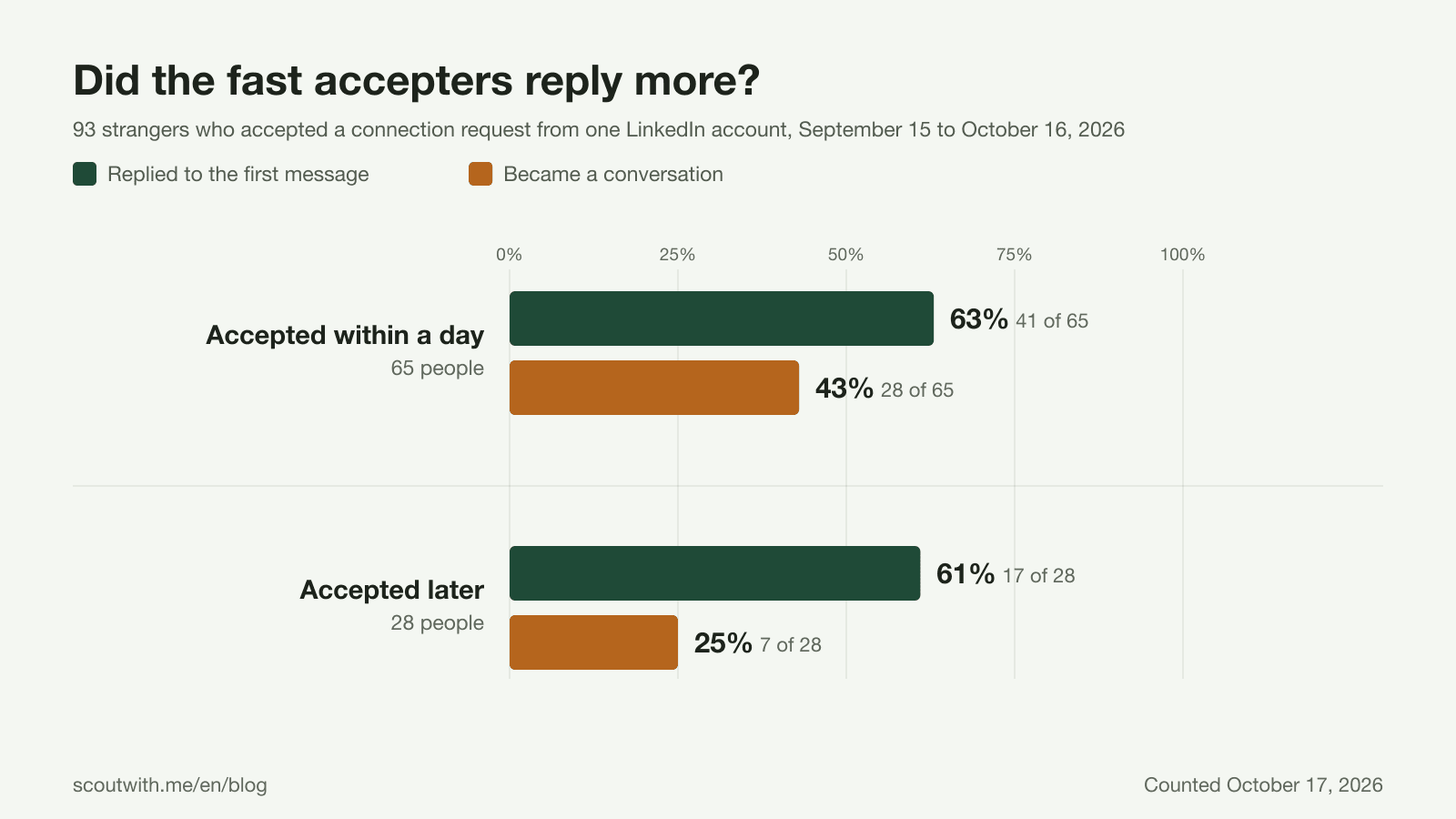
No: 63% of the people who accepted within a day replied to the first message, the same rate as the people who took longer, across 93 acceptances counted on October 17, 2026. The speed of the acceptance said nothing about the reply.
| Accepted | People | Replied to the first message | Rate | Only those with a full week to answer |
|---|---|---|---|---|
| Within a day | 65 | 41 | 63% | 30 of 48 |
| Day 2 to 7 | 24 | 15 | 63% | 12 of 19 |
| After day 7 | 4 | 2 | 50% | 2 of 4 |
A fast acceptance tells you one thing: the person opened LinkedIn that day. The people who took a week were away from it, or came back to one of LinkedIn's reminders, and once they were back they read the message and answered it like everyone else. The signal that did move replies in this campaign is a different one, the date of the person's last post, and it is counted in Does posting on LinkedIn predict who replies?
Do people who accept fast turn into conversations more often?
A little, in this batch: 43% of the people who accepted within a day became a conversation, against one in four of those who took longer, as counted on October 17, 2026. A conversation here means the person wrote at least twice and did not say no.
| Accepted | People | Conversations | Rate | Said no | Only those with a full week to answer |
|---|---|---|---|---|---|
| Within a day | 65 | 28 | 43% | 3 | 19 of 48 |
| Later | 28 | 7 | 25% | 3 | 7 of 23 |
Among the people who had a full week to answer, the gap narrows to 40% against 30%, and 23 people is too few to call that a rule. The no came from both sides in the same small number. Read it as a direction: someone who accepted the same day was more often in the middle of something the note touched, and someone who accepted a week later was more often clearing notifications. Neither group should be dropped, and neither should be chased harder. How conversations and refusals are read, one person at a time, is in Is it rude to cold message strangers on LinkedIn?
What does a fast LinkedIn acceptance mean?
That the person was on LinkedIn that day, nothing more: 70% of the 93 acceptances came within a day of the request, as counted on October 16, 2026, and the two largest published samples show the same share. A fast acceptance is the normal case, not a sign of interest.
| Sample | Size | Accepted within a day | Period |
|---|---|---|---|
| This account | 93 acceptances of 173 requests | 70% | September 15 to October 16, 2026 |
| Belkins, 53 B2B client projects | 152,636 contacts | 62% | March 2025 to February 2026 |
| Botdog | 16,492 requests | 63% | 2025 |
Belkins puts the median at one day and 91% of acceptances within two weeks; Botdog counts a fifth of acceptances in the first hour and 88% in the first week. Neither study crosses the speed of the acceptance with what the person did afterwards, and I did not find a published study that does, which is why this page exists. On the slow side, the mechanics are LinkedIn's: its help page on connections and invitations says a request stays pending for six months and that LinkedIn sends the recipient up to two reminders before it expires. A late acceptance is often an answer to a reminder, not to your note. How long to wait for one, and when to withdraw, are in How long do LinkedIn connection requests take to be accepted? and How many LinkedIn connection requests per week does prospecting take?
What to do with this
- Send the first message to everyone who accepts, on the day they accept, however fast or slow the acceptance was. The reply rate was the same.
- Do not read a fast acceptance as interest, and do not read a slow one as a no. Fast is the normal case in every sample, and slow is often a LinkedIn reminder.
- If you have to choose whom to write first, use the signal that did move the numbers here: the date of the person's last post, not the speed of the acceptance.
- Judge the silence after your message, not before it. Replies to a message arrive within a day, and after three or four days of silence one follow-up is the move, as counted in Do LinkedIn follow-ups work?
- Keep the slow accepters on the list. One in four of them became a conversation, and three of 28 said no.
Scout notices the acceptance and drafts the first message from the person's profile the same day, fast or slow acceptance alike; approving it and having the conversation stay yours.
How these numbers were measured
- Source: Scout running on my own LinkedIn account, prospecting for real, for the products I sell. No data from other users of Scout; the app keeps its data on each user's computer and sends nothing to us. The two external samples are Belkins' and Botdog's, linked above, and are theirs alone; the rule on pending requests is LinkedIn's, from its help page, read on October 18, 2026.
- What was counted: request, a connection request with a note written from the profile, to someone who was not a connection; accepted within a day, the acceptance appeared less than 24 hours after the request; accepted, the time the app's sweep saw the acceptance, not the moment of the person's click, so a few slow acceptances may have been faster than recorded, and five of the 28 were seen on a Monday morning after a Thursday or Friday request; first message, the message sent after the acceptance, which all 93 received; replied, the person wrote back at least once after it, follow-ups included; conversation, the person wrote at least twice and did not say no; said no, the person declined politely or asked not to be contacted; a full week to answer, the acceptance came at least seven days before the count.
- When: requests sent from September 15 to October 16, 2026; acceptances read from a copy of the database taken at 22:48 on October 16; replies and conversations from a copy taken at 22:19 on October 17, both in the account's local time (Eastern European summer time).
- Size and rounding: 93 acceptances: 65 within a day, 24 from day 2 to 7, 4 later. The slow group is 28 people, 23 of them with a full week, so the conversation gap is a direction, not a rule. Rates are rounded to whole percentages; "one in four" is 7 of 28.
- Not measured: whether a late acceptance followed one of LinkedIn's reminders; the hour of the click; the content of the notes, which were written the same way for everyone.
- Left out: one person who was already a connection and got the first message without a request; the 80 requests not accepted by October 16, withdrawn or still pending. Nobody is named, no message is quoted.
- The rules that apply to every post are in How the numbers on this blog are measured. Every rate on this blog, refreshed together, is on the benchmark page.
This is a living page: acceptances and replies keep arriving, and the changelog below says when the counts were last read.
Changelog
- 2026-10-18: first version. 93 acceptances of the requests sent from September 15 to October 16, read on October 16; replies and conversations read on October 17.