experiment · · 9 min read
What makes a first LinkedIn message get a reply? In 96 messages of 41 to 61 words, nothing in the text moved the 51%: what moved it was who received it
96 first messages sent after a LinkedIn connection request was accepted, between September 16 and October 19, 2026. All of them 41 to 61 words, with one question at the end and the person's name. 49 got a reply. Length, number of questions, time of day and how soon after the acceptance made no difference to the rate. What made a difference was who received the message, and whether I read it before it went out.
by Thiago Valentim · Scout With Me, by Worth Contacting
The person accepted the request, and now it is your turn to write. That is where the questions every guide answers with opinion show up: how long the message should be, whether it ends with a question, whether to send it now or tomorrow morning. I had 96 messages to answer that with a count.
Between September 16 and October 19, 2026, 96 people received a first message from my LinkedIn account: 95 had just accepted a connection request sent without a note, and one was already a connection. Each message was drafted by software from the person's profile and, except for ten, read by me before it went out. The app kept the text of every one, so what each message contained can be measured without quoting any of them: characters, words, sentences, questions, the hour it went out and how long after the acceptance. 49 got a reply.
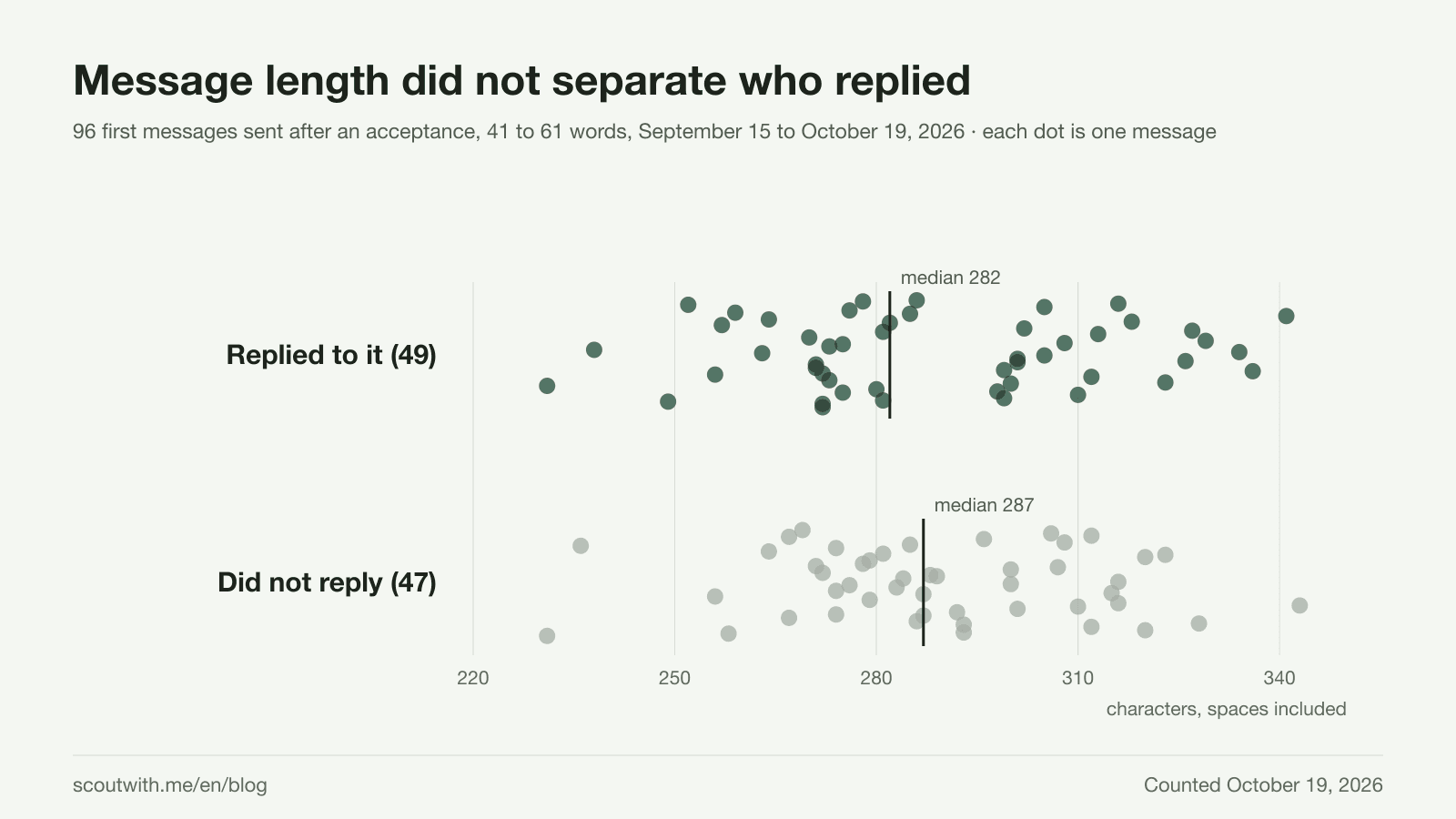
How long should a first LinkedIn message be?
Under 60 words, and within that, length did not matter: the 96 messages ran from 41 to 61 words, 49 got a reply (51%), and the ones that got a reply were the same length as the ones that did not, 289 characters on average in both groups, as counted on October 19, 2026.
| Message length | Messages | Replied | Rate | Only those with a full week to answer |
|---|---|---|---|---|
| Up to 275 characters | 32 | 19 | 59% | 12 of 23 |
| 276 to 300 characters | 31 | 12 | 39% | 6 of 22 |
| 301 or more | 33 | 18 | 55% | 15 of 28 |
The three bands go up and down in no order: the middle one is the worst and the longest nearly ties with the shortest. With thirty messages per band, that is ordinary noise, not a signal. Words give the same picture: up to 45, 8 of 17; 46 to 52, 31 of 59; 53 or more, 10 of 20. What the whole range says is something else: no message went past 61 words, and half the people replied.
The only study with a number I found is LinkedIn's own, about InMail, the paid message recruiters send to people who are not connections: across tens of millions of InMails sent between May 2021 and April 2022, messages under 400 characters got replies 22% above average, those up to 800 were 5% above, and those over 1,200 were 11% below, according to LinkedIn's InMail study. Only 10% of InMails were under 400 characters. All 96 here stayed under 350, inside the band LinkedIn measures as the best, and it is inside that band that length stopped mattering.
One question or two? Three sentences or five?
The second question makes no difference, and the sentences give only a direction: 38 of the 75 messages with one question got a reply (51%) and 11 of the 21 with two (52%), as counted on October 19, 2026.
| What the message had | Messages | Replied | Rate |
|---|---|---|---|
| One question, at the end | 75 | 38 | 51% |
| Two questions, one of them in the greeting | 21 | 11 | 52% |
| Three sentences | 13 | 6 | 46% |
| Four sentences | 61 | 35 | 57% |
| Five sentences | 21 | 8 | 38% |
All 96 end with a question, and in the 21 with two the first one is the greeting's, along the lines of "how are you?". It added nothing and took nothing away. The only difference that shows is between four sentences and five, and 21 five-sentence messages are too few to call a rule; among those with a full week to answer, 23 of 44 against 5 of 16. Read it as "do not pad", not as "cut a sentence". A single message had six sentences, and it got no reply.
Should you send the first message the moment the person accepts?
It makes no measurable difference: 47 messages went out within an hour of the acceptance appearing and 25 got a reply (53%); the 44 that went out between an hour and a day later got 22 (50%), as counted on October 19, 2026.
| Sent after the acceptance | Messages | Replied | Rate | Only those with a full week to answer |
|---|---|---|---|---|
| Within 1 hour | 47 | 25 | 53% | 17 of 36 |
| 1 to 6 hours | 25 | 11 | 44% | 8 of 18 |
| 6 to 24 hours | 19 | 11 | 58% | 6 of 14 |
Four went out more than a day later, and one got a reply; too few to say anything. The time of day did not change anything either: in the morning, 21 of 40; in the afternoon, 11 of 20; in the evening, 16 of 34. The "acceptance" here is the time the app's sweep saw it, so the person's real wait may have been a little longer. In practice: sending the same day is enough; nobody has to stand guard to answer in the minute of the acceptance. When the replies come in, by hour and weekday, is on the benchmark page.
What did move the reply rate?
Who received the message: the 23 messages of the week of October 12 got 16 replies (70%), against 38% to 53% in the four weeks before, with the same kind of text, as counted on October 19, 2026.
| Week the message went out | Messages | Replied | Rate |
|---|---|---|---|
| September 14 | 17 | 9 | 53% |
| September 21 | 12 | 6 | 50% |
| September 28 | 27 | 11 | 41% |
| October 5 | 16 | 6 | 38% |
| October 12 | 23 | 16 | 70% |
The week of October 12 has not even had its full seven days yet and is already the best. What changed in it was not the message: it was the search, which returned more of the right people, 69 fits in 120 names, as counted in How many LinkedIn profiles do you have to read to find one worth messaging? The other signal that separates who replies is visible before you write, the date of the person's last post, and it is the measure in Does posting on LinkedIn predict who replies?
One thing about the process showed up too: of the 86 messages I read before approving, 47 got a reply (55%); of the 10 the app approved on its own, 2 (20%). Nine of those ten went out in the first two weeks, when the drafts did not sound like me yet, so the effect of reading cannot be separated from the effect of the week. Read it as a direction, and as a reason to read. The week I tuned the voice of the drafts is counted in How much time does LinkedIn prospecting take per week?
What to do with this
- Write up to 60 words, three or four sentences, one question at the end. Within that, do not spend time cutting or stretching: across 96 messages, it changed nothing.
- Do not add a second question to offer options. The 21 with two did the same as the 75 with one.
- Send on the day of the acceptance, when you can. Within an hour or at the end of the day, the rate was the same.
- Spend the time you save on who receives it: the search, the date of the last post, the reading of the profile. That is what separated 70% from 38%.
- Read every message before it goes out. The 10 that went out unread got 2 replies.
Scout drafts the first message from the profile, at this length and with one question at the end, and leaves it waiting for your reading; approving it and having the conversation stay yours.
How these numbers were measured
- Source: Scout running on my own LinkedIn account, prospecting for real, for the products I sell. No data from other users of Scout; the app keeps its data on each user's computer and sends nothing to us. The external study is LinkedIn's, about InMail, linked above, and is theirs alone.
- What was counted: first message, the message sent after the acceptance of a request without a note (95) or to a person who was already a connection (1), drafted by software from the profile; characters, spaces included; words, split on spaces; sentences, stretches ending in a full stop, question mark or exclamation mark, with a greeting without a full stop counted together with the next sentence; questions, sentences ending in a question mark, the greeting's included; hours after the acceptance, from the time the app's sweep saw the acceptance to the send; read before it went out, approved by me, in the text that was sent; approved on its own, sent by the app without my reading; replied, the person wrote after it and before the first follow-up; a full week to answer, the message went out at least seven days before the count.
- When: messages sent from September 16 to October 19, 2026, read from a copy of the database taken at 23:24 on October 19, in the account's local time (Eastern European summer time).
- Size and rounding: 96 messages, 73 of them with a full week to answer. The length bands hold 31 to 33 messages. Groups under ten get no row: four messages sent more than a day after the acceptance, two sent at night, one with six sentences, five redone before approval. Rates are rounded to whole percentages.
- Not measured: what each message said, because the app does not keep which part of the profile it used; the tone of the replies, which is in Is it rude to cold message strangers on LinkedIn?; the effect of follow-ups, which is in Do LinkedIn follow-ups work?
- Left out: the messages the person sent, the follow-ups and my own replies. No message is quoted; nobody is named.
- The rules that apply to every post are in How the numbers on this blog are measured. Every rate on this blog, refreshed together, is on the benchmark page.
This is a living page: every new acceptance brings a new message, and the changelog below says when the counts were last read.
Changelog
- 2026-10-21: first version. 96 first messages from September 16 to October 19, measured on October 19.